Tunee string quartet music

Can Tunee make a usable string quartet draft?

The short answer is yes as a documented starting point, not as proof of a finished score. The Tunee string quartet music page describes a workflow for two violins, viola, and cello, then asks you to judge the brief, arrangement, export, cost, and rights yourself.

This guide uses vendor-stated examples and is not an independent audio benchmark.

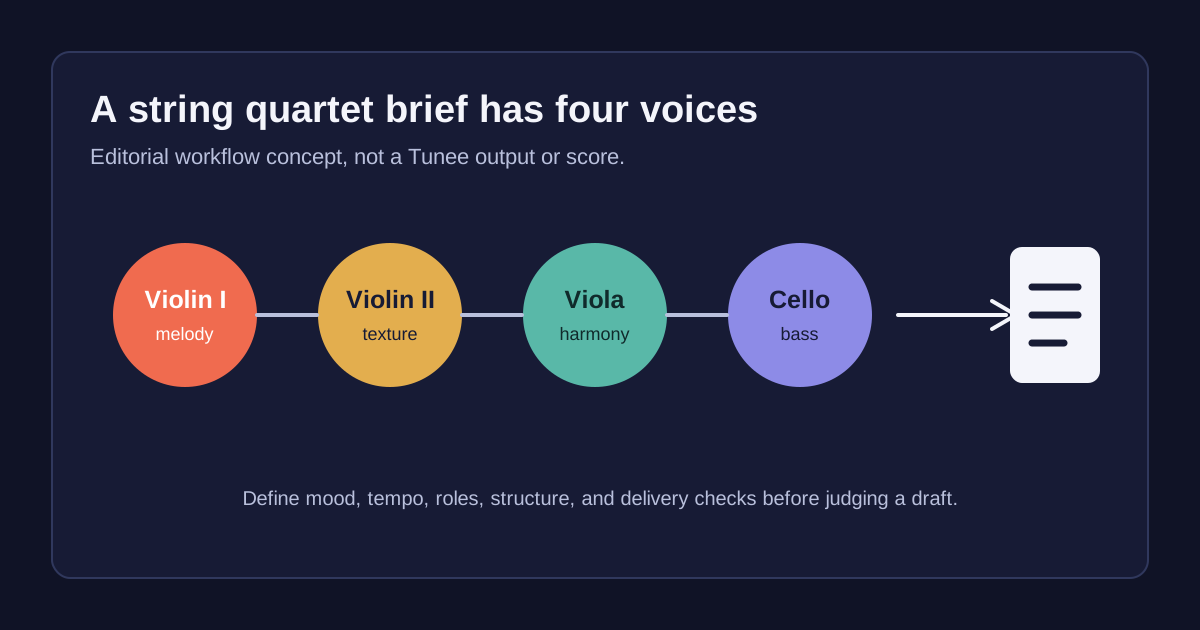
Editorial diagram showing violin one, violin two, viola, and cello feeding one music brief
Editorial workflow concept by Tunee Review; not a Tunee output, score, or performance recording.

What does the Tunee string quartet music workflow actually establish?

Tunee's official page presents a dedicated string quartet music generator and a sample brief that assigns a role to each instrument. For Tunee string quartet music, the useful evidence is the input and workflow shown on that page, not an assumed quality result. It also shows ready-to-use prompts and a three-step path: describe a vision, refine it through chat, and export the track. Those are useful inputs for a Tunee string quartet music test. They do not establish that every generated quartet has correct counterpoint, printable notation, separate instrument parts, or rights that match your release. That boundary should guide the Tunee string quartet music decision.

Worth testing when

  • You need a fast chamber-music sketch for a scene, event, or arrangement idea.
  • You can judge an audio draft before commissioning or editing a final performance.
  • You are willing to check export access, credits, and current account terms.

Do not rely on it alone when

  • The deliverable requires engraved notation or musician-ready parts.
  • A release depends on a settled copyright or licensing conclusion.
  • You need a verified quality benchmark rather than a vendor example.

Give the Tunee string quartet music page four jobs to solve.

A vague request such as “make classical music” gives you little to compare. A better Tunee string quartet music brief names the ensemble, the emotional turn, the tempo, and what each voice should do. The Tunee string quartet music workflow becomes easier to judge when the same brief can be repeated.

Define the four voices

State whether Violin I carries the melody, whether Violin II supplies tremolo or dialogue, whether the viola sustains inner harmony, and whether the cello anchors the bass or answers the theme.

Define the delivery

Add key, approximate BPM, duration, structure, scene or event context, and the format you need to review. If you need notation, ask how the account actually exposes it instead of assuming an audio export contains a score.

Example brief: “Create a 30-second F-minor, andante quartet. Let Violin I carry a lyrical line, Violin II use restrained tremolo, the viola hold warm inner notes, and the cello move with a walking bass. End on a clean cadence for a scene cut.” This is a Tunee string quartet music test input, not a claim about the result.

How to evaluate Tunee string quartet music without guessing.

A Tunee string quartet music review is more useful when it records the brief, the revision, and the handoff rather than only the first listen.

1

Write one fixed brief

Keep the ensemble, tempo, mood, duration, and delivery goal stable. Save the exact prompt so a second Tunee string quartet music draft is comparable.

2

Review the first arrangement

Listen for the intended melody, voice separation, awkward doubling, timing, unwanted artifacts, and whether the ending fits the scene or event.

3

Ask for one targeted revision

Change one variable at a time: a tempo, a voice role, a cadence, or a transition. Record the visible model, credit estimate, and revision cost.

4

Check the handoff

Confirm whether the account provides the audio format, download access, stems, notation, or other files your next collaborator needs.

What the official Tunee string quartet music example can and cannot prove.

The official Tunee string quartet music page shows a sample prompt in F minor with named roles for all four instruments, plus a written assistant response describing the intended result. It also publishes prompt ideas across classical, romantic, minimalist, cinematic, fugue, and folk directions. This is valuable evidence of the page's intended workflow and prompt design, not a Tunee string quartet music benchmark. For this Tunee string quartet music guide, the source is a starting point for questions, not a substitute for your own acceptance check.

QuestionWhat the official page showsWhat still needs checking
Can I specify each instrument?The sample brief assigns roles to two violins, viola, and cello.Whether the generated audio consistently follows those roles across retries.
Can I refine the arrangement?The page describes conversational refinement of tempo, key, instruments, and structure.How many revisions your plan permits and how credits are charged.
Can I export a score?The page describes downloading a high-quality audio track.Whether notation, individual parts, stems, or your required format are available.
Can I release it commercially?The vendor page uses broad commercial-ready language.Current plan-specific rights, attribution, certificate wording, and jurisdiction limits.

Source checked November 11, 2026: official Tunee string quartet music page. Vendor claims are quoted as claims, not independent findings.
Questions to answer before using a quartet draft.

Can Tunee string quartet music produce individual instrument parts?

The official page describes a full quartet score in its FAQ language, but this site has not verified printable parts or a separate-part export. Confirm the actual account output before promising material to performers.

Is Tunee string quartet music ready for film or event release?

It can be a candidate for a test, but release readiness depends on the current plan, export, rights, and your own review of timing and musical fit. The official example is not a measured film cue or event deliverable.

What should I save from a Tunee string quartet music test?

Save the brief, prompt revisions, selected audio, visible model and credit information, export settings, and the rights text shown at the time of download. Those records make the decision auditable.

When should I use a composer instead?

Use a composer or a more controllable scoring workflow when you need exact picture timing, engraved notation, performer-ready parts, repeatable motifs, or a contractual rights answer that the current account does not provide. That is the main boundary for a Tunee string quartet music decision.

Test one short Tunee string quartet music brief before paying for a larger workflow.

Use a fixed quartet prompt, compare one targeted revision, and check the export and rights details in the live account before treating the result as production material.

Is Tunee string quartet music worth a test?

Our verdict: Tunee string quartet music is worth a small, documented test if you need an arrangement sketch and can evaluate audio without assuming that a vendor example equals a finished score. We recommend: start with one fixed brief, one revision, and a written export-and-rights check. Keep a composer or a more controllable workflow in the plan when notation, exact timing, or contractual ownership is the real requirement. Treat Tunee string quartet music as a draft path until those checks are complete.